Showing posts with label From the Archives. Show all posts

Friday, October 16, 2015

From the Archives: "Gentleman Jim" Corbett's on 33rd Street

Today our 34th Street archivist Anne Kumer shares some history of the 34th Street district. This post also appears on NYC Circa.

James "Gentleman Jim" Corbett was the heavyweight boxing champion in 1892. He won the title in the 21st round of a fight with the (so far) undefeated John L. Sullivan. Boxing was still illegal in most U.S. states in the late 1800s; New York State didn't legalize it until 1896, and it wasn't made an Olympic sport until 1904.
James "Gentleman Jim" Corbett, 1910. Image: LOC
Corbett legitimized the sport for many by bringing grace and style to the ring. This, along with sharp dressing and a rumored college education earned him the nickname "Gentleman Jim." He followed his career in boxing with a successful one in stage acting. Sometime in the late 1800s he opened a cafe on Broadway, just north of 33rd Street, and named it Corbett's.

Corbett's on Broadway and 33rd Street looking north, 1900. Image: MCNY
Corbett's fit in well in the neighborhood, then an area full of restaurants, bars, and smaller theaters. Actors and publishers were known to drop by, and it was conveniently located near the elevated Sixth Avenue train.

34th Street, where Sixth Avenue and Broadway meet, with the Corbett's sign on the left, 1901. Image: NYPL
The turn of the century brought big retail to the area, and many of the buildings in the neighborhood were razed to make way for large department stores. Andrew Saks bought the properties on the corner of 34th Street where Sixth Avenue and Broadway meet, including the Corbett's building. Saks built his 34th Street flagship store on that corner in 1901. Gimbels followed one block south with a store in 1910, and in the late 1930s, the elevated train went underground.

Saks 34th Street, 1955. Image: MCNY
Though the 34th district is populated with plenty of bars and restaurants, retail still dominates the streetscape. 
34th at Broadway, 2015. Image: 34SP, Anne Kumer


Tuesday, October 13, 2015

From the Archives: Tammany on 33rd Street

Today our 34th Street archivist Anne Kumer shares some history of the 34th Street district. This post also appears on NYC Circa.

A short distance from Corbett's, on 33rd Street between Fifth and Sixth Avenues, in an inconspicuous townhouse, was one of the city's most notorious gambling halls, the House with the Bronze Door. With lavish interiors designed by Stanford White of McKim, Mead and White, and an entrance fortified by a reclaimed 15th century bronze door, the House kept the wealthy in, and unsympathetic lawmakers out. (There were plenty of sympathetic lawmakers at the poker tables too.)
Men playing cards c. 1900. Image: LOC
Players won big and lost bigger in the House's gaming rooms, which included roulette, poker, baccarat. In case of raids, guests could escape through a secret route via an adjoining building. Owner Frank Farrell used the profits from the House with the Bronze Door to fund over 200 other illegal gambling dens throughout the city. He also used the profits to bribe members of law enforcement, most of who belonged to the Tammany Society, a corrupt political machine that controlled city and state politics for decades.

Harper's Weekly cartoon by William A. Rogers showing NYC Chief of Police "Big Bill" Devery collecting "taxes". Image and further explanation: Harp Week

Members of the Tammany Society were widely known to accept and require bribes and selectively enforce laws. Public approval of the organization fluctuated, though its powerlessness in the face of Tammany was recognized by several media outlets. With low rates of literacy, satirical cartoons reached a much wider audience than written diatribes could. It was a winning hand, and they accomplished in part, what Tammany feared the most, exposure to, and criticism from, the public. One of the most notable cartoonists was Thomas Nast of  Harper's Weekly. Throughout his years at the paper, he produced a huge number of sardonic cartoons for the heavily circulated weekly, often showing Tammany as an irate tiger destroying everything in its path.


Harper's Weekly cartoon by Thomas Nast, November 11, 1897 showing Tammany tiger mauling democracy (depicted as Columbia with a crushed ballot box by her side) in a Roman Colosseum as Boss Tweed cheers from the stands. Image: OSU

Reformists, such Reverend Charles C. Parkhurst and Jerry McAuley played huge roles in publicizing Tammany's wrongs through well-attended sermons. In 1891 Reverend Parkhurst inaugurated a campaign against Tammany Hall. He gave sermons throughout the city denouncing public officials, and made it his personal mission to shut down all gambling halls. The effort eventually succeeded with the closure of several gaming rooms throughout the city, including the House with the Bronze Door in 1908. The defeat was celebrated in person and in print, though the Tammany Society would continue to operate in some form or other for several more decades.

Reverend Charles C. Parkhurst enjoys a brief victory over Tammany in this cartoon by J.S. Pughe, printed in an 1894 edition of Puck. Image: LOC

Further Reading:
1. Dash, Mike. Satan's Circus: Murder, Vice, Police Corruption, and New York's Trial of the Century
2. Halloran, Fiona Deans. Thomas Nast: The Father of Modern Political Cartoons
3. Gilfoyle, Timothy. A Pickpocket's Tale
4. Santé, Luc. Low Life

Tuesday, April 28, 2015

From the Archives: From Mail Bags to Designer Bags

Today, in honor of New York Fashion Week's move to Moynihan Station, our 34th Street archivist Anne Kumer shares some history of the building also known as Farley Post Office. This post also appears on NYC Circa.

In the early 1900s, much of Midtown Manhattan west of Seventh Avenue was residential. Situated between the city's dirty ports and arguably just as dirty as the Tenderloin district, the area was home to low income families and the generally disenfranchised. Developers saw it as the perfect location for a new railway station that would connect Manhattan to the state of Pennsylvania. They purchased property, and most of the residents were pushed out of the area and into neighborhoods farther north.

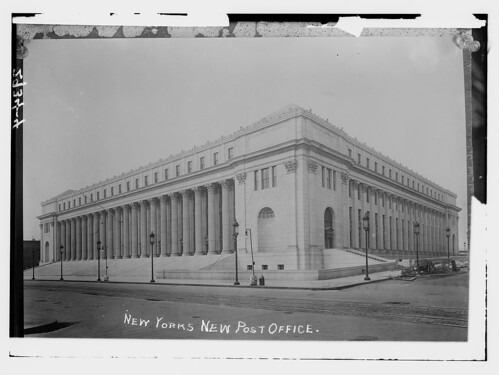
When Penn Station was built in 1910, it brought commuters, pleasure seekers, and commerce straight into Manhattan from across the Hudson river and farther west. The Farley Post Office building, then known as the Pennsylvania Terminal Building, just to the west, was built right after completion of Pennsylvania Station, and opened to the public in September, 1914. Both buildings were designed and built by McKim, Mead &White, and both played a significant role in turning the neighborhood from residential to commercial.

Overview of Farley and Penn Station, looking west. Smaller apartment buildings and brownstones are still visible to the buildings' north (right of the frame). Photo: MCNY

N.Y.'s new Post Office (LOC)
Image: LOC

Image: Pisark's Cards

In 1914, Ira Schnapp, who at the time was designing stamps for the Postal Department, was hired as a stone carver by the US Post Office Department to design, and hand-carve the famous quote on the building's front facade:

NEITHER SNOW NOR RAIN NOR HEAT NOR GLOOM OF NIGHT STAYS THESE COURIERS FROM THEIR APPOINTED ROUNDS

The quote comes from Herodotus' Histories 8.98, and refers to Angarum, the royal riding post in the Persian Empire. Schnapp had previous experience carving, having completed the front facade of the New York Public Library in 1911 when he was just 19 years old.

Around 1918, Penn Terminal was renamed General Post Office Building.

General Post Office Building, 1920. Photo: NYPL Digital

In 1933, President Franklin Delano Roosevelt appointed James A. Farley as the 53rd Postmaster General. Under Farley's leadership, a western annex was added onto the existing building in 1934, and The General Post Office building was extended all the way to Ninth Avenue, giving it superblock status. Farley served until 1940, successfully managing the postal service during the Great Depression, and greatly improving trans-continental mailing services.

Farley Post Office Mail Sorting Room, [1914-1915]. Image: LOC 
Now the site of the future Moynihan Station, the Farley building may soon be converted back into a functioning train station and civic center. The project has its own history dating back to the 1990s, when New York State Senator Patrick Moynihan first suggested the conversion. For now, it continues to adapt yet again, to the city's changing needs, as the new location for New York Fashion Week.

Tuesday, March 10, 2015

From the Archives: The Queen of Staccato

Today our 34th Street archivist Anne Kumer shares some history of the 34th Street district. This post also appears on NYC Circa.

Luisa Tetrazzini, also known as the Queen of Staccato, was a coloratura soprano, famous for her vocal range and flexibility. She achieved the kind of international fame that only seems available to pop stars today, and performed regularly in Europe and the United States from the 1890s into the 1920s. The Library of Congress has several recordings of her here.

Luisa Tetrazzini, c. February 16, 1911. Image: LOC

In 1908 Tetrazzini signed a five-year contract with Oscar Hammerstein to sing at The Metropolitan Opera House in New York City. Just a few years into this contract, they had a dispute over money and venues. He wanted her to sing in New York; she loved, missed, and was eager to return to San Francisco. Her response was truly Bay Area: she took to the streets, and on Christmas Eve, 1910, gave a free concert at the corner of Market and Kearney, near Lotta's Fountain. The city and its citizens, still recovering from the damage caused by the 1906 earthquake, were grateful, and showed their support in numbers.


Tetrazzini's SF street show, Christmas Eve, 1910. Image via
Back in New York, Tetrazzini performed at the  Hippodrome on Sixth Avenue between 43rd and 44th Streets numerous times throughout her career and was one of the most popular performers in the city.
Ticket line for a Tetrazzini concert at the Hippodrome, 1919. Image: LOC
She also lived in the Hotel McAlpin (now Herald Towers).

Broadway, looking south with the Hotel McAlpin on the right, 1921. Image: MCNY

On December 3, 1920 Tetrazzini gave a recital via "radio telephone" from her room at the McAlpin. Arranged by Army Signal Corps, it was the first attempt to provide long distance entertainment to troops deployed overseas and aboard naval ships. Her voice was heard by hundreds on ships in port and at sea within 400 miles of New York City. As a thank you, Private Fred Bennett of Fort Wood, Staten Island, stationed aboard one of the ships, sang "A Tumble Down Shack in Athlone" back over the airwaves to Tetrazzini. 

On Christmas Day of that same year, she gave another meaningful performance at the McAlpin, this time as Mrs. Santa Claus to the hotel's visiting and permanent resident children.

In addition to being a famed musician, she was the namesake for the dish Chicken Tetrazzini. There are varying accounts as to the origin of the recipe, but all can agree that it was named after and inspired by Tetrazzini. James Beard attributes the recipe to chef Ernest Aborgast at The Plaza Hotel in San Francisco; I'm tempted to believe him just because of my undying love for this book.

Louis Paquet, chef de cuisine of the Hotel McAlpin won four prizes in the 1920 Hotel Men's Exposition at the Grand Central Palace. Around this time, Tetrazzini also gave him her recipe for  Spaghetti Tetrazzini, a dish that remained on the McAlpin menu for several years.

Enrique Caruso, Luisa Tetrazzini, two men, Nipper the dog, 1914. Image: LOC

Here is Luisa singing along with a recording of Caruso. It's the only surviving film footage of her, and twas taken upon her retirement in 1932. At 62, and following a prolific performing career, her voice is still as strong as ever, and her laugh at the end is delightful.


Wednesday, February 11, 2015

From the Archives: Liberty Corner

Today our 34th Street archivist Anne Kumer shares some history of the 34th Street district. This post also appears on NYC Circa.

The Broadway Tabernacle Church was formed as a pulpit for the reformist preacher Charles Grandison Finney in the mid-1830s. Finney was an advocate of social reform, primarily equal education for all people regardless of race or gender, as well as a proponent of the growing abolition movement.  The church auditorium was one of the city's largest public halls, and hosted rallies, scientific demonstrations, and lectures, as well as sermons.

In 1842 noted geologist Sir Charles Lyell gave a series of lectures on Uniformitarianism, the then groundbreaking theory that the earth is developed and shaped by slow moving forces still in effect. Two years later, the church hosted the first public demonstration of nitrous oxide used as an anesthetic.

Broadway Tabernacle auditorium at Worth Street and Broadway, 1850. Image: NYPL

For its many community functions, the Tabernacle was best known (and hated by some) for supporting the abolition and women's rights movements. Angry mobs attempted to burn down the church during construction, and at times the lives of its preachers and congregants were put at risk. Women's suffragette and activist Sojourner Truth famously spoke at the Women's Rights Convention in 1853 held at the Tabernacle. Boos, hisses, and protests were so raucous that the convention earned the nickname The Mob Convention of 1853. 

Sojourner Truth, 1864. Image: LOC
Frederick Douglass along with William Lloyd Garrsion spoke at the church several times before it moved again, this time to 34th Street where Broadway and Sixth Avenue meet. By then, the church was known as Liberty Corner for its commitment as " . . . a center for every good cause, civic or religious, that needed rallying," The Literary Digest, 1905-01-07.Pastor Joseph Parrish Thompson gave frequent anti-slavery sermons, invited black preachers to the pulpit, and with other members of the church, founded The Independent, a weekly anti-slavery newspaper.

NE Corner of Sixth Avenue and 34th Street showing the Broadway Tabernacle Church [1900], Image: NYPL
Pastor Thompson resigned in 1871, and soon after, William MacKergo Taylor took over pastoral duties. Taylor put an emphasis on missionary work, and advanced the rights of female congregants by giving laywomen the right to vote within the church. He also established Bethany Church on 33rd Street and Tenth Avenue, a mission church that was operable into the 1920s.


Broadway Tabernacle Church interior with a Ferris & Stuart organ, 34th Street, 1859. Image: via

In 1901, the church and congregation  moved to 57th Street and Broadway, and then later, again, this time to its present location at 93rd Street and Broadway. It is now called the Broadway United Church of Christ. In its place, at the NE corner of 34th Street and Broadway, the Marbridge building, an office building with retail space was built. (ed. note: Victoria's Secret is currently the anchor tenant of the building)

The Marbridge Building, 1941. Image: MCNY

Other Sources:
1. Sir Charles Lyell, Eight Lectures on Geology
2. Library of Congress, Sojourner Truth online resources
3. Ward, Susan Hayes. The History of Broadway Tabernacle Church, 1901
4. Judd, Lewis Strong. The Broadway Tabernacle Church, 1901-1915

Thursday, August 7, 2014

From the Archives: Empire Views

Today our 34th Street archivist Anne Kumer shares some history of the 34th Street district. This post also appears on NYC Circa.

On March 17, 1930 construction began on the Empire State Building. It was built by the newly formed Empire State, Inc., who took their name from the moniker bestowed on New York State by George Washington in 1785. Designed by Shreve, Lamb & Harmon (who also created another 34th Street District treasure, the Gimbels Traverse) and built during the Great Depression, the new office tower became a symbol of perseverance and hope. E.B. White wrote of it in his 1949 essay "Here is New York": "The Empire State Building shot twelve hundred and fifty feet into the air when it was madness to put out as much as six inches of new growth."

It opened just over  a year later on May 1, 1931. Over 5,000 visitors stood in line at the street level on a rainy day to view the city from what was then the tallest man-made structure in the world (NYT, 1931-05-04).
Visitors to the 86th Floor on opening day, May 1, 1931. Image: tumblr
The 86th floor observation deck immediately became a popular destination for tourists. A photographer was on hand to capture the moment, which was then printed on a postcard.
Visitor Postcard photo taken on the Empire State Building observation deck, 86th Floor, May 8, 1934; front. Image: private collection (Pisark's)
Visitor Postcard photo taken on the Empire State Building observation deck, 86th Floor, May 8, 1934; back. Image: private collection (Pisark's)
Visitor Postcard, Empire State Building Observation Deck, 86th Floor, August 1935. Image: private collection (Pisark's)
Visitor Postcard, Empire State Building Observation Deck, 86th Floor, [1930s]. Image: Private collection (Pisark's)

Visitation to the observation deck increased throughout the 1930s and into the next decade, despite a few setbacks in the 1940s. On July 28, 1945 a B-25 Bomber crashed into the north side of the building during a routine personnel transport mission killing 14 people and injuring elevator operator Betty Lou Oliver. The building was re-opened the following Monday.


Just two years later, a photography student named Robert Wiles happened upon the aftermath of Evelyn McHale's suicide and took a photograph. The photo, published by LIFE magazine on May 1, 1947 is still regarded as one of the most poignant portraits of suicide.

Following this and other incidents, building management announced the forthcoming construction of an additional steel barrier along the building's parapet. A New York Times article also stated that during the Empire State Building's first 16 years of operation, there were 9,000 visitors, and only 15 suicides (with just one instance of injury to a pedestrian below) (NYT, 1947-05-11).

The steel barrier and parapet, 1948. Image: Private collection (Pisark's)

Though taller and larger buildings continue to rise throughout the city, the Empire State Building remains one of the city's greatest treasures, and receives nearly 3.6 million visitors a year.

Other Sources and Sites of Interest:
-Empire State Building Historical Timeline
-Empire State Building fact sheet
-Columbia University Avery Architecture and Fine Arts Library, Empire State Building Archive

Tuesday, June 10, 2014

From the Archives: Herald and Greeley Before and After

Recently, we sent photographer Angelito Jusay out to take some shots of the new horticulture installations in Herald and Greeley Square Parks. To compare, we looked back at some photos taken from the same angles nearly 20 years ago. A lot has changed.

Herald Square looking north, early 1990s:

Photo: 34SP
Herald Square looking north, April 2014:
Photo: Angelito Jusay Photography for 34SP

Greeley Square looking south, early 1990s:
Photo: 34SP
Greeley Square looking south, April 2014:
Photo: Angelito Jusay Photography for 34SP

Thursday, January 2, 2014

From the Archives: Koster and Bial's Music Hall on 34th Street

Let's start the new year with a history post on a vaudeville venue that predated Macy's Herald Square's flagship location. Written and researched by 34th Street Partnership's archivist Anne Kumer, this post also appears on NYC Circa.

Throughout the late 1800s Manhattan's Theater district crept northward towards along the city's Great White Way towards Times Square. Herald Square was home to several music and dance halls including Koster and Bial's. The theater's former location was a bit south at the corner of Sixth Avenue and 23rd Street. Two days after closing the 23rd Street location, John Koster and Albert Bial opened a new music hall with the same name on 34th Street between Seventh Avenue and Broadway.  On August 28, 1893 the hall opened its doors to the public, eight years before Macy's would buy the property, demolish the building, and build their famous flagship store.

Exterior of Koster and Bial's on the north side of  West 34th Street between Seventh Avenue and Broadway, 1896. Image: MCNY

Interior of the 34th Street Koster and Bial's Music Hall, 1896. Image: MCNY

Strobridge Lithographing, 1896. Image: LOC

A popular vaudeville venue with varied stage performances, Koster and Bial's hosted burlesque and acrobatic acts, as well as a whole host of musical performances.
Fannie Leslie [1896]. Image: NYPL
Trick horse of Emile outside the music hall's 34th Street entrance, 1896. Image: MCNY
Among the many dancers who made regular appearances at the venue, was "La Carmencita," also known as "The Pearl of Seville." Carmen Dauset was born in Seville, Spain in 1868, and began performing at the age of 12 in 1880. She made her American debut at the 23rd Street Koster and Bial's in February 1890, but performed several times at the 34th Street location.
The dancer as portrayed by painter William Merritt Chase, 1888. Image via

One of a few portraits painted of the dancer by painter John Singer Sargent, 1890. Image via
The theater was also the chosen location for the first exhibition of Thomas Edison's Vitascope projector on April 23, 1896. Originally invented by C. Francis Jenkins and Thomas Armant, and called a Phantoscope in 1895, the two inventors both claimed the invention as theirs after dissolving their partnership. It was soon sold to Thomas Edison, in what sounds like a similar situation to the Emile Berliner gramophone incident in the late 1870s. The Edison Manufacturing Company renamed the machine the Thomas Edison Vitascope, and continued manufacturing it.

The first theatrical exhibition of a a film projection machine, the Vitascope. April 23, 1896 Image: LOC

Edison's company went on to produce 100s of "actuality" films -- watch them -- documenting real life scenes with little or no narrative. Here is a film of Carmencita made in 1894, most likely with one of Edison's previous camera inventions: the kinetograph or kinetoscope:


Almost since the day it opened, the theater was plagued with financial and management issues. On July 17, 1901 Macy's announced the purchase and future demolition of the property to make way for the flagship store at 34th Street and Broadway. Three days later, Koster and Bial's held their last performance on the rook garden, ending with a chorus of performers and loyal customers singing "Auld Lang Syne."

You can still find a plaque commemorating the Hall's existence just outside the 34th Street entrance to Macy's.

Other Sources:
-Snyder, Robert. The Voice of the City: Vaudeville and Popular Culture in New York.

Monday, December 2, 2013

From the Archives: The New York Aquarium at 35th Street and Broadway

Because we don't do Cyber Monday on 34th Street, today we are looking back at what will be the new location of Urban Outfitters with some retail history from archivist Anne Kumer. A slightly different version of this post appears on NYC Circa, a New York City history blog.

One of the more outlandish things in Midtown Manhattan during the 1800s was The New York Aquarium, located at the NW corner of 35th Street and Broadway.


The aquarium was a short-lived, but very ambitious venture, founded by William Cameron Coup and Charles Reiche. Coup was already well-known for his collaborations with P.T. Barnum -- he helped set up and managed P.T. Barnum's Museum, Menagerie and Circus.

 The New York Aquarium opened on October 11, 1876. The building was 20,000 square feet, and included space for exhibition as well as research. The centerpiece of the main pavilion was a 30-foot tank intended to house a whale, or, whales (plural). Additional tanks flanked the whale tank, intended for sea lions and elephant seals, and tanks along the pavilion's north and east walls housed fish.

Image: MCNY
In his memoir Sawdust and Spangles, Coup devotes a chapter to the Aquarium and it's specimens. It sort of reads like a manual on how not to transport aquatic animals from distant places. Even so, his enthusiasm and love for the creatures comes through. He starts with a description of a rare species of Japanese fish that has three tails (it's a goldfish), and continues with a description of whale transport  that involved a days-long journey by boat from the Norwegian coastline to Canada, then a 90-hour train ride from Canada to New York City. Three died en route on separate journeys before one was delivered alive and transferred to the aquarium on October 15, 1876, a few days after the aquarium's official opening.

The whale exhibited -- briefly, before it too died -- was most likely a beluga whale. 

White Whale, drawing, c. 1820: source

The year 1870 brought the aquarium's first sea lions, another main attraction. Pinnipeds have been exhibited in captivity since around the 1600s, but this exhibit was likely one of New York's first. The pinniped pen was located next to the whale tank, and drew guests from all over.

In 1879 Coup and Reiche disagreed on the practice of opening the business on Sundays --  Reiche was for it, and Coup against. Reiche bought out Coup's share of the company and went on to pursue other enterprises.

The aquarium closed in 1881, and the NW corner of 35th and Broadway soon became known for its theater venues, first as the location for the New Park Theater in 1883, and from 1894 until 1914, the home of the Herald Square Theater.

Monday, November 25, 2013

From the Archives: The Nantucket Sea Monster

We can't wait for the parade! Last week we featured some Macy's Thanksgiving Day Parade history, and today our 34th Street archivist Anne Kumer covers float designer Tony Sarg and one of his Macy's balloons. This post also appears on NYC Circa.


Macy's Thanksgiving Day Parade float designer Tony Sarg owned a curiosity shop in Nantucket, Massachusetts. In the summer of 1937, and with the help of many others, he staged an unusual sighting off the coast using one of his Macy's balloons, the Nantucket Sea Monster.

The initial sighting off the coast of Nantucket, MA

Footprints are found and measured on the shore.

Spectators examine the beast

Some are more daring than others

Tony Sarg with fellow spectators and the Nantucket Sea Serpent.
The Nantucket Sea Serpent made its debut the following November in the 1938 Macy's Thanksgiving Day Parade.


 All of the following images, plus more, can be viewed on the Nantucket Historical Association's flickr page.

Here is a video of the "discovery" from the NHA YouTube channel.


text text