Showing posts with label retail history. Show all posts

Friday, October 16, 2015

From the Archives: "Gentleman Jim" Corbett's on 33rd Street

Today our 34th Street archivist Anne Kumer shares some history of the 34th Street district. This post also appears on NYC Circa.

James "Gentleman Jim" Corbett was the heavyweight boxing champion in 1892. He won the title in the 21st round of a fight with the (so far) undefeated John L. Sullivan. Boxing was still illegal in most U.S. states in the late 1800s; New York State didn't legalize it until 1896, and it wasn't made an Olympic sport until 1904.
James "Gentleman Jim" Corbett, 1910. Image: LOC
Corbett legitimized the sport for many by bringing grace and style to the ring. This, along with sharp dressing and a rumored college education earned him the nickname "Gentleman Jim." He followed his career in boxing with a successful one in stage acting. Sometime in the late 1800s he opened a cafe on Broadway, just north of 33rd Street, and named it Corbett's.

Corbett's on Broadway and 33rd Street looking north, 1900. Image: MCNY
Corbett's fit in well in the neighborhood, then an area full of restaurants, bars, and smaller theaters. Actors and publishers were known to drop by, and it was conveniently located near the elevated Sixth Avenue train.

34th Street, where Sixth Avenue and Broadway meet, with the Corbett's sign on the left, 1901. Image: NYPL
The turn of the century brought big retail to the area, and many of the buildings in the neighborhood were razed to make way for large department stores. Andrew Saks bought the properties on the corner of 34th Street where Sixth Avenue and Broadway meet, including the Corbett's building. Saks built his 34th Street flagship store on that corner in 1901. Gimbels followed one block south with a store in 1910, and in the late 1930s, the elevated train went underground.

Saks 34th Street, 1955. Image: MCNY
Though the 34th district is populated with plenty of bars and restaurants, retail still dominates the streetscape. 
34th at Broadway, 2015. Image: 34SP, Anne Kumer


Monday, October 28, 2013

From the Archives: Choc Full o' Nuts

Today, to celebrate the opening of Broadway Bites, our 34th Street archivist Anne Kumer shares some dining history of the district. This post also appears on NYC Circa.

For many years a Choc Full o' Nuts lunch counter occupied retail space in the ground floor of the Hotel McAlpin, now, Herald Towers building, at 34th and Broadway. Like most restaurants in Midtown Manhattan, it was packed around lunchtime. 

December 1954, Alfred Eisenstaedt. Photo: LIFE via this blog post.
Choc Full o' Nuts opened its first store near Times Square at Broadway and 43rd Street, in 1926. The company continued to grow, opening its first cafe opened in 1932, and following with food trucks.


Possibly the first store, c. 1926 Photo: Pinterest


Food cart from the 1930s or 1940s. Photo: here
The company's founder was William Black, who, as his business grew, also became a well respected philanthropist. He donated a lot of money towards medical research, and in 1957 founded the Parkinson's Disease Foundation with an initial donation of $100,000.

One of Choc's most well known employees was famed baseball player Jackie Robinson. Shortly after retiring from baseball in 1956, he was hired as the company's Vice President and Director of Personnel. Mr. Robinson was an extremely vocal Civil Rights advocate as well. NARA has a great collection of his letters. 

William Black and Jackie Robinson at a store opening. Photo: NYT
The comments section of this post by Ephemeral New York includes many fond memories of the franchise in the city.

For a while, Choc Full o' Nuts at 34th Street and Woolworth's supplied Midtown workers with two solid lunch options flanking Herald Square. The 34th Street lunch counter closed in 1990.

Where do you go to get an Egg Cream now?

Thursday, July 18, 2013

34th Street Retail History: 1992 - 2013

The retail landscape on 34th Street changes at a rate that often surprises me, even with years of documenting 34th Street retail under my belt. Just when I think nothing new could possibly join our district, someone moves out, or revamps their building, or goes bankrupt. 

Our archivist gathered photos to represent this constantly changing landscape via a video history of buildings and retailers on 34th Street. Below is our newest version, featuring H&M Penn Station, Victoria's Secret Herald Square, the Macy's corner at 34th and Broadway, and 213-215 West 34th, now home to DSW, Joe Fresh, and Payless.


New retailers are coming to 34th Street as we speak: a Swatch boutique is opening in the old Billabong space, Crocs is taking over the old Tad's Steaks, Urban Outfitters is going into 1333 Broadway, Esprit remains closed (although as-yet-to-be-unnamed retailers are looking), and Journey's has left Herald Center, which is slated for a big overhaul and possibly an exciting new store.

Also, early next week we should be able to announce a new brand joining Footaction, Lane Bryant, Cohen's Fashion Optical, Payless, Joe Fresh, and DSW on the West End of 34th Street between Seventh and Eighth Avenues, a block that's had huge turnover in the past year. Go West, young and old shoppers, because retail on the street is expanding towards the Hudson.


Thursday, July 11, 2013

From the Archives: Woolworth's in Herald Square

In this post, archivist Anne Kumer shares some retail history. A slightly different version of this post appears on NYC Circa, a New York City history blog.

Eleven years after B. Altman opened store at 34th and Fifth, the Woolworth's Board of Directors announced that the company would build a large store at the NE corner of 40th Street and Fifth Avenue. The new "Five and Ten Cent Store deluxe" Woolworth's opened in the Fall of 1917.

Parade route along Fifth Avenue -- most likely a WWI send-off parade. The parade is heading south; the view looking north. The Woolworth's store is on the far right, and brownstones where the future Arnold Constable building are to its right (north). Date, ca. 1917  Image: NYPL
Over ten years later, in 1930, the first supermarket was built in Jamaica, New York, making it possible for food shoppers to obtain most, if not all, of their groceries under one roof. That, along with the growth of the suburbs throughout the 1930s, popularized discount retailing. Discount retailers such as Woolworth's, and in the 1950s, Korvette's and McCreery's, offered frequent sales, less individualized customer service, and savvy merchandising to attract a wide range of customers.

Window shopping on Fifth Avenue, ca. 1930. Image: MCNY
Throughout the 1930s, Woolworth's continued to grow and expand operations throughout the U.S. and in Canada. There was at least one store in the 34th Street Partnership District during this time. This one, in Herald Square, at the corner of 35th Street and Broadway, boasted a lunch counter large enough to accommodate 500 people at one time.

Woolworth's at 35th Street and Broadway, c. 1927 Image: Collection of Dan Pisark
In 1937, the NYT announced that plans were filed to build the company's 1,000th store further uptown at 39th Street and Fifth Avenue, just one block south of the existing flagship store. It opened a year later, in 1938, sixty years after the the first  "Woolworth's Great Five Cent Store" was opened in in Utica, New York.
Fifth Avenue looking north from 39th Street, ca. late 1930s / early 1940s. Image: Pisark
The new Woolworth's store was designed by architects Starrett & van Vleck, known for designing the flagships of several other department stores, including Lord & Taylor on Fifth Avenue between 38th and 39th Streets (It's still there.).

Woolworth's shopper shot by Stanley Kubrick, 1947. Image: MCNY
The F.W. Woolworth Company went defunct in 1997, and as of 2001 the company has been part of Foot Locker Inc.

There are two Foot Locker stores in the 34th Street area, each within blocks of the former Woolworth's store at 35th Street and Broadway, aka 1333 Broadway, which will soon undergo another retail transformation when Urban Outfitters moves in.


Other Sources
Union League Club Landmarks Preservation Commission Report, LP-2389
This book from Google book.
Wikipedia

Thursday, May 30, 2013

From the Archives: Saks and Gimbels on Sixth

Today our 34th Street archivist, Anne Kumer, shares some retail history of the district. This post also appears on NYC Circa.

A few short years before the ground broke for Penn Station, construction was underway in Herald Square for a retailer new to the city: Saks. The company, founded by Baltimore merchant Andrew Saks, chose Herald Square as the location for its first New York store in part because of its proximity to the Sixth Avenue elevated train and rumored Penn Station. Along with Macy's and a little later, Gimbels, these major stores would soon redefine Herald Square as a retail hub of the city.

View from Greeley Square, looking north at Herald Square, around 34th Street and Broadway, 1901. Image: MCNY

The Saks building was designed by architecture firm Buchman & Fox, the same firm that would later design the World's Tower building on West 40th Street. Though Saks and Macy's were more or less neck and neck with their store construction and opening announcements, Saks still managed to open its doors just five weeks before Macy's in 1902. Unlike Macy's, a store composed of several departments, Saks in the early 1900s sold only clothing, making it not quite a true department store. Around the same time, one avenue over, Benjamin Altman was purchasing lots on Fifth and 34th to build his new store B. Altman & Co.

The completed Saks building at West 33rd Street with its competitor Macy's one block north at West 34th Street, 1902.Image: MCNY
Saks and Macy's coexisted, offering consumers slightly different inventories -- Saks was an upscale clothing-based retailer, and Macy's catered to the general consumer with a large variety of merchandise-- until 1909, when another large retailer, Gimbels, joined the fray. Founded by Adam Gimbel in Vincennes, Indiana, Gimbels built its first large store in Philadelphia, PA, before constructing a New York branch just one block south of the Saks store, on Sixth Avenue between 32nd and 33rd Streets. Three large department stores in a row + public transportation = retail district.

Gimbels store at Sixth Avenue, between 32nd and 33rd Streets, 1912, thirteen years before the Gimbels Traverse was built. Image: MCNY

Model wearing a Gimbels dress, 1914. Image: LOC

Similar to Macy's, Gimbels was a large department store and family business.  Adam Gimbel had several sons, many of whom worked for the Gimbels Company: Isaac Gimbel became President in 1894, and was the driving force behind the store's expansion to the New York market; that same year, Ellis Gimbel took over Public Relations and advertising for the company. In 1921, he started the first Thanksgiving Parade in Philadelphia, PA, three years before Macy's began its iconic parade in New York City.

The company purchased Saks in 1923, and one year later, created the Saks Fifth Avenue brand, and opened its first store. The 34th Street location was kept open, and the Saks 34th brand was created. High end retail was moving farther north along Fifth Avenue, and the building's out-of-date construction (it didn't have escalators) were key factors in the decision to close the store in 1965.

Looking north from Greeley Square with the Gimbels and Saks buildings on the left, [1965]. Postcard: Anne

In 1967, discount retailer Korvette's moved into the Saks building. They "modernized" the facade, as seen below. Founded in 1947 by Eugene Ferkauf in a small store on Fifth Avenue and West 47th Street, Korvette's expanded quickly, with 2,684 stores in operation by the mid-1960s. This decade also saw a general rise in the national presence of discount retailers.

Same view as above, [1969]. Postcard: Anne
Gimbels stayed open until 1986. When it finally closed, it was cited as the store with the largest shoplifting rate of any in the country, largely because of the Gimbels Corridor. Originally built as a convenience to shoppers, the underground passageway connected the store to Penn Station a couple blocks away, and provided shoplifters with an easy escape. By the 1970s, the corridor had a horrible reputation and was the scene of more than a few gruesome crimes. This very opinionated description from a NY Post article pretty much sums it up: "In the midst of teeming Midtown, bare-bulb fixtures like those in mines marked a path through a Calcutta-like sprawl of diseased, predatory humanity."

After Gimbels closed, the building was renovated, and in 1989, reopened as A&S Plaza, and is now the home of JC Penney and the Manhattan Mall. Next door, the Saks building, now the Herald Center Mall, is slated for yet another makeover.


Wednesday, May 8, 2013

From the Archives: B. Altman's Palace of Trade Moves Uptown

Today our 34th Street archivist, Anne Kumer, shares some retail history of the district. This post also appears on NYC Circa.

Retailer Benjamin Altman of Altman & Co. opened his first large store in 1886 at Sixth Avenue and 19th Street. Though he previously occupied smaller stores in various parts of the city, this location was quickly dubbed "Palace of Trade" for its vast inventory and size. Business was great, and soon Altman was looking to expand yet again. Noticing the increasing numbers of mansions appearing along Fifth Avenue, he chose the corner of  West 34th Street and Fifth Avenue for the new flagship location of his store. At the time, the area was quiet, residential, and didn't look at all like it would support a large retail outlet.

34th Street looking east from Fifth Avenue, 1870. Image: NYHS

Altman purchased his first lot under an employee's name (Benjamin Jenkins) rather than his own, on the SE corner of Fifth Avenue and 34th Street in 1892. Shortly after, he set up the Wallingford Realty Company to handle all future transactions. Between 1892 and 1904, the company brokered a total of 28 purchases and long-term leases on behalf of Altman, gradually taking control of almost the entire block between 34th and 35th Streets and Madison and Fifth Avenues. By the time construction of the new building began in 1905, there was still one "holdout" building on the corner of 34th Street and Fifth Avenue, occupied by the Knoedler Gallery. Altman would have to wait another five years to acquire that property and expand the store all the way to Madison Avenue. In the meantime, on October 6, 1906 the new store opened for business.
Corner of 35th Street (left) and Fifth Avenue looking SE, 1906. The shorter building to the far right is the "holdout" property at 34th Street and Fifth Avenue. Image: LOC
The gallery held onto their corner until their lease ended in 1910 and they were forced to give up the property. Altman wasted no time on the store expansion he'd envisioned many years prior. He died just before the full-block expansion was completed in 1913, but just after he founded the philanthropic organization, the Altman Foundation.
 
Corner of Fifth Avenue (left) and 34th Street (right), just after the building's addition along Madison Avenue, about 1915. Image: MCNY
The interior of the Altman store was designed in a Palazzo style reminiscent of the Parisian Bon Marché, one of the world's first department stores. Skylights filtered light into the center of the main arcade, and steps led customers to multiple levels of departments that sold just about everything imaginable. A consummate traveler, Altman was known to go on yearly buying trips around the world in search of new and diverse merchandise.

Interior of the B. Altman arcade, 1908 Image: NYPL
Most, if not all, of the extensive bronze and iron work in the building was done by Brooklyn-based company Hecla Bronze and Iron Works. NYPL has several images in their digital archive of the Hecla Bronze and Iron Works building -- which thankfully is landmarked -- including their showroom with vaulted ceilings.


B. Altman & Co. was primarily known for catering to a well-off female customer. One who could spend hours looking at furs:

Selling floor for furs, 1914. Image: NYPL
And one who pursued the latest fashion trends. I was possibly born in the wrong century. I would wear all of these blouses today, right now.

Page from the B. Altman & Co. 1913 Summer Apparel catalog. Image: Duke University
The prude in me wishes bathing suits would move a little back in time and cover more skin like the ones shown here. The one second from the left is especially fetching. Bonus: all the lady ones are work-appropriate by today's standards! And black -- so much black! (I love it).

Page from the B. Altman & Co. 1913 Summer Apparel catalog. Image: Duke University
Aside from being at the forefront of fashion, Altman's was known for popularizing retail business practices that would eventually become commonplace. The best example is the story of the extremely wealthy and miserly Hetty Green (pictured here and here) purchasing a bolt of fabric from the Altman's at Sixth Avenue between 18th and 19th streets sometime in the mid-1800s, and then deciding she didn't like it. Returning merchandise was not accepted practice, but Mrs. Green went back to the store and asked for an exchange or her money back. Altman himself granted the return and she was so grateful that she vowed to act as guarantor to any future business loans. He never took her up on her offer, but they did stay in touch, and she introduced Altman to several of her financier acquaintances, who in turn got him interested in art collecting. Over the years, Altman amassed a massive art collection, now housed at the Metropolitan Museum of Art in NYC. You can read the collection handbook here and see some of the pieces here.

After several more successful decades, the Altman company was forced to sell the store to the L.J. Hooker Retail Group in 1985 and close the building in 1989. Today, the building is primarily occupied by City University of New York (CUNY) Graduate Center, and the NYPL Science, Industry, and Business Library (SIBL), but from the outside it still looks like a palace of trade.

Other Sources:
-Altman Company Department Store Building, 335-371 Fifth Avenue. Landmarks Preservation Commission, March 12, 1985; designation list 176, LP-1274
-Bruce, John S. Jr. 100 The First Century: A History of B. Altman & Co.
-Hendrickson, Robert. The Grand Emporiums: The Illustrated History of America's Great Department Stores.
-Zola, Emile. The Ladies' Paradise.
-Department Store museum website

Monday, March 11, 2013

The Topshop 34th Street Rumor Gets New Wings

Thanks to an article in WWD last Friday, the Topshop 34th Street rumor is back in action and getting traction from other outlets. Herald Center is slated for renovation (Staples has moved out, Daffy's is closed), and sources say the building owner is "...looking for a full-priced retailer. They would try to make a play for Topshop." 

Herald Center today

Hallelujah to that. If you check our Topshop archives, you can see we've been extolling Topshop 34th Street rumors since 2008. This is by no means official or confirmed, but Topshop would be a natural retail progression following retailers like Zara, Uniqlo, and Urban Outfitters who have made or are making 34th Street Herald Square a home.

All this talk of retailers and renovations at Herald Center evokes the site's storied history. The building was the original home of Saks, built in 1902. Saks sold to Gimbels (who had a home down Sixth Avenue in what is now Manhattan Mall) and Gimbels turned it into "Saks 34th Street," while Saks moved up to its new home on Fifth Avenue. This New York Times article outlines the rather fascinating retail history of the building and the neighborhood. Can you believe that the bones of the building pictured below are still under the building pictured above?

Saks circa 1925

The facade has changed through the years, but I like to think the Ghost of Saks Past now haunts the empty aisles of Staples and Daffy's, waiting for a new retailer to restore the building to its former department store glory.

Tuesday, November 29, 2011

From the Archives: Finding a Bargain under the Gimbels Traverse

In this post, 34SP's archivist Anne Kumer shares some 34th Street history. This post also appears on NYC Circa, Anne's history blog about New York City and its public spaces and buildings.


I LOVE dollar stores, especially Jack's. It's chaotic for sure (I have to be in the mood for an adventure), but there are great deals on a huge variety of merchandise. The first Jack's was opened at 16 East 40th Street, between Fifth and Madison Avenues. In 1994 Jack opened a second store on the first floor of 110 West 32nd Street, between Sixth and Seventh Avenues, and three years later, a closeout retail store called Jack's World, on the 2nd and 3rd floors in the same building. Here is 110 West 32nd Street in 1912 -- it's the middle building with the sexy cornice and Penn Station in the background to the west.

Photo: MCNY
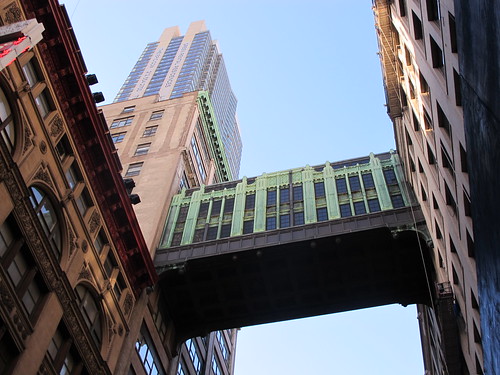
The photo above was taken just after the completion of its neighbor to the west, known then as the Cuyler Building, and later as the Gimbels Administration Building, and even later, as one host to the Gimbels Traverse, or skybridge (more on that later). As for the "Jack's" building -- visible below to the left of the skybridge -- it was probably built in the early 1900s.

Manhattan, West 32nd Street, b/t Sixth Avenue & Seventh


According to  Walter Grutchfield's extremely informative website on New York City wall signs, 14 to 42, the building was occupied by a company called Alliance Press from about 1907 to 1938, and Protective Ventilator Co. from 1910-1916.  In 1916, Willoughby's Camera Stores purchased the building, setting up a much-loved shop on the ground floor. The camera and photography store (one of NYC's oldest) was there until 1994, bringing us full circle to Jack's. Again, 14 to 42 gives a concise history of Willoughby's, so I'm not sure I need to.  I can, via the MCNY photo collection, contribute a Willoughby's window from 1945:

Photo: MCNY

Thursday, October 6, 2011

A Little 34th Street Retail History

Lately I've been fielding 34th Street retail questions from the press like "What used to be in the new Timberland space?" and "Who was there before Uniqlo?" Sadly, I found myself digging around in my archives because I was coming up blank. This is either a reflection of my compromised brain or a testament to the speed in which the city's landscape is changing. I prefer the latter. Anyway, while frantically struggling with "Who the hell was in the new Levi's space just one year ago?" (Foot Locker, duh), I thought "Video!"


My favorite transformations are Victoria's Secret and Old Navy. Many thanks to my video intern, Adrian Nienaber, and Anne Kumer, our archivist, for putting this together. Saying we have a lot of 34th Street photos is a big understatement. If you're interested in district storefronts or building facade photos, we are here for you. Well, Anne is here for you, I'll just be passing your email along.

Wednesday, August 31, 2011

From the Archives: A Relic of Early Modernism in Midtown Manhattan

In this post, 34SP's archivist Anne Kumer shares some 34th Street retail history. This post also appears on NYC Circa, Anne's history blog about New York City and its public spaces and buildings. 

Recently, I went shopping with 34th Street fashion guru and Fashion Herald author Tricia, and she noticed the new Steve Madden store, along with a few guys talking in front of it who did not look like tourists, casual passersby, or purchasers of the 5-inch heels Madden is known for. (That last one is an unfair assumption. I have for sure seen many a gent rock a heel way better than I can in this city.) We accosted them, and after explaining what we do for the district, found out that one was the architect for the store. He then dragged us out into the street saying that we were right this minute across from one of the most beautiful buildings in the city. This one -- 22 West 34th Street.

Photo: A. Kumer, 34SP
I had noticed the building before, but never thought much past why is there would so much wall and so little window. Also, it's backed up against the Empire State Building on 34th Street, so it isn't as if there's nothing else to look at. He had such a glow in his eyes as he described the unusual modernness of this design for the time it was built, that I can only imagine he sees it like this instead.

Photo: NYPL digital collection

Designed by architecture firm De Young, Moscowitz & Rosenberg, and built in 1934, it's known in my trusty AIA Guide to New York City, and the above photo, as the Spear & Company building. Originally established in Pittsburgh in 1843, Spear's was a furniture store known for selling knockoffs of modern-style pieces. In addition to a whole lot of facade wall, the building was equipped with air conditioning, indirect lighting, and an auditorium, and cost about $300,000 to build.

In a 1938 New Yorker Skyline column, Lewis Mumford (also cited in Christopher Gray's 1995 Streetscape column) accused the building's designers of practicing fake functional with that small bank of windows facing east, and covered by the Spear's sign, which was yellow neon on a blue background.

By the early 1990s, many of the windows were painted over, Spears was long gone, and signage on the building looked like this:

Photo: N. Mintz, 34SP

A few years later, and a lot of work on behalf of the 34th Street Partnership, the wall sign is gone, though there is still a remnant of a vertical sign and masked windows.

Photo: 34SP
Now thankfully, (scroll all the way up for a refresher), the windows are unobstructed by vertical signage and paint. Mumford would be at least a bit more pleased.


Additional citation:
The Architectural Guidebook to New York City, by Francis Morrone and James Isla, p. 140