Showing posts with label 34th Street district. Show all posts

Wednesday, January 2, 2013

From the Archives: Happy 100th Birthday McAlpin Hotel

Today our 34th Street archivist, Anne Kumer, helps us wish Happy 100th Birthday to one of our favorite residential buildings, the Herald Towers. This post also appears on NYC Circa.

It's now a residential building called the Herald Towers that somewhat blends in with surrounding tall architecture, but when it was first built in 1912, the McAlpin hotel was a formidable presence. At 25 stories tall, it was the largest hotel in the world with 1,500 rooms, not including the Turkish bath, roof garden (a solid amenity if there ever was one), ballroom (throwback to the Gilded Age), and convention hall (meh).

The McAlpin going up, March 1912. Photo: MCNY

The building was designed by American architect Frank Mills Andrews and besides its fortuitous location next to the Sixth Avenue El train, it was smack in the center of rapidly changing part of the city. In 1912, the Macy's store on West 34th Street and Broadway (across the street) was celebrating its tenth year, and the area was quickly transforming from the den of sin it was in the late 1800s to a retail and hospitality center. A few blocks away on 34th Street at Park Avenue, the Vanderbilt Hotel was under construction; the Titanic sank in April 1912, taking with it Macy's founder Isidor Strauss; and the first monument dedicated to a woman was celebrated in Bryant Park. One year earlier, the New York Public Library opened its doors to the public, and in 1913, the Grand Central Oyster Bar opened its doors. In short, people were traveling, shopping, and eating out more.

The hotel McAlpin opened for business on December 29, 1912, a Monday.

Photo: LOC

A year after the hotel's opening, members of the Blackfoot Confederacy from Montana visited the hotel. The visit was arranged by Louis W. Hill, fonder of the Northern Railroad Company to promote train service from western states.

Photo: MCNY
All sorts of PR stunts were staged, some with phonographs.

Photo: MCNY
The McAlpin was also one of the first hotels to rent ground-level space to retailers. By 1917,  the hotel's owners had purchased additional frontage along the 34th Street entrance, and were slated to add 200 more rooms.

Photo: NYPL
The McAlpin was also known for its restaurant located in the Alpine Cellar, called the Marine Grill, not so much for the food, as for the decor. The walls and ceilings were covered in Terra Cotta murals based on paintings by Fred Dana Marsh, and showed the history of the New York harbor. 

Marine Grill, c. 1924. Photo: MCNY
The restaurant eventually closed, but thankfully the murals were rescued and are now installed at the Chambers Street / Park Place A train stop as part of the MTA's public art program.

And . . . . as a bonus, I give you cartoon spats!
Postcard: From the collection of Dan Pisark
 

Tuesday, November 27, 2012

From the Archives: The New York Herald Building, Then and Now

Today our 34th Street archivist, Anne Kumer, delves a little deeper into the history of the New York Herald building. This post also appears on NYC Circa.

The New York Herald building at West 35th Street where Broadway meets Sixth Avenue, was a two-story building designed by Stanford White of architecture firm McKim, Mead & White. White was commissioned to build it for friend James Gordon Bennett Jr. to house the new Herald offices when the paper moved uptown from Park Row in 1894. The story of the Herald and its founders are here, here, and here.

Photo: MCNY
The Herald had offices in this building until Bennett Jr.’s death in 1918. Soon after, Frank Munsey bought the paper and merged it with the New York Sun to create the Herald-Sun. The new combo-paper’s offices were moved to West 42nd Street. 

The north half of the building was demolished in 1921, leaving only the southern part, statues intact on the  building’s façade. 

Photo: MCNY
Eventually, in 1930, a new, 24-story office building was designed and built where the northern half used to be, by the architecture firm Clinton & Russell. The firm was founded in 1894, the same year the Herald building was completed (weird coincidence!) by Charles Clinton and William Hamilton Russell.

Photo: Berenice Abbott via the  NYPL and MCNY
In the 1930s the Sixth Avenue Group (a business improvement group of sorts) sponsored a contest to re-design and “beautify” the area following construction of a new underground subway line and station, and the razing of the Sixth Avenue elevated line. The low rise portion of the Herald building was completed in 1940. I’m pretty sure that "completed" meant that the building was stripped of its Stanford White-designed façade work and given the 1940s-1950s simple (sterile) treatment. The front windows are much larger in the new building, and the ground floor looks lower, but I think the building's original bones are still there. That same year, the James Gordon Bennett memorial was installed in Herald Square in the form of a 40 ft. tall monument, unveiled during a dedication ceremony on November 19, 1940. 

Postcard from the collection of Dan Pisark
Herald Square and the surrounding area went into a decline in the 1970s and 1980s, but were brought back to life with a late 1990s renovation by the 34th Street Partnership (ed. note: Fashion Herald is a blog managed by the Partnership). 

Additional Sources:
Kruger, Richard. The Paper: The Life and Death of the New York Herald Tribune
“Sixth Ave. Group to Beautify Parks,” NYT, March 24, 1939
“Frank A. Munsey Buys the Herald and the Telegram,” NYT, January 15, 1920


Monday, November 5, 2012

From the Archives: The James Gordon Bennetts' New York Herald, Part 3

As you shop 34th Street and browse Macy's Herald Square, did you ever ask yourself "Why Herald Square?" Today is the last of a 3-part series on the New York Herald from our archivist Anne. This post also appears on NYC Circa, a blog about New York City and its history.

After returning to the States, Bennett commissioned Stanford White to design new offices for the Herald. The new building would be located a fair distance from Park Row and competitor Joseph Pulitzer's World building, completed in 1890. Bennett obtained a 30-year lease at Sixth Avenue and 35th Street, at the south border of a small clearing then known as Dodge Plaza in honor of William Earle Dodge, who I've mentioned before.

Park Row, and most of the competition
Bennett chose the new site for its proximity to public transportation and nightlife. The elevated train line had been built a few years before, and now afforded the public, including Herald's reporters, easy access to most parts of the city. The site also bordered Tin Pan Alley, and several music halls and theaters, including places like Jim Corbett's and the Haymarket.

Corbett's, said to be a hangout spot for JGB Jr., c. 1900. Photo: MCNY
No stranger to scandal himself, Stanford White designed an elaborate Renaissance Revival building based on Fra Giancondo's Loggia del Consiglio, a late 15th century seat of the local city council in Verona. The Loggia's roof was lined with sculptures of famous poets, including the risque poet Catallus. It is said that this inspiration was chosen on purpose as a nod of sorts to the Herald's coarse nature and Bennett's sporting life.

Instead of poets lining the roof, Bennett chose his spirit animal, the owl. (The more I learn about him, the more hipster he starts to sound: a bearded, heavy drinking, somewhat arrogant but also creative person with an abundance of family resources and a questionable work ethic. Insert "Put a Bird on it" joke here.) In any case, he claims that an owl's cry saved him at sea during his Civil War service.

The Herald building shortly after construction. Postcard property of Dan Pisark.
A couple of them are now incorporated in the Bennett memorial in Herald Square. I've written of the monument before, and so have others. . .

Ever-conscious of public perception, Bennett mandated that there would be windows along the Broadway side of the building allowing passersby to view the presses below. People loved it and regularly crowded at them to watch sheet after sheet of the Herald come off the presses.

The Herald building's elaborate western facade and people crowding near the windows, c. 1902 Photo: Library of Congress
And, what they saw below:
The Herald presses, c. 1902. Photo: Library of Congress
The acclaim of the building and increased commerce of the area led to a name change for the Square. It became known as Herald Square in the late 1890s. Still a commercial hub, now instead of newspapers, the square welcomes millions of daily shoppers.

Ed. note:  I asked Anne if any of Stanford White's building remains in what is now 1350 Broadway, and she thinks the bones of the building are left but "the ornate façade has been stripped."

Part 1 can be found here; part 2 here.


More sources:
Broderick, Mosette. Triumvirate, McKim, Mead & White: Art, Architecture, Scandal, and Class in America’s Gilded Age.

Monday, October 22, 2012

From the Archives: The James Gordon Bennetts' New York Herald, Part 2

As you run from store to store on 34th Street, did you ever ask yourself "Why Herald Square?" Today's post is part 2 of a 3-part series on the New York Herald from our archivist Anne. This post also appears on NYC Circa, a blog about NYC and its history. 

In 1866 James Gordon Bennett Sr. passed the publishing duties of the New York Herald on to a man who many thought to be an unlikely successor -- his son James Gordon Bennett Jr.

Image: NYPL
James Gordon Bennett Jr. is best known in history for his devotion to yachting, ballooning, and socializing on a grand scale. Mostly due to the Herald's commercial success he was raised to cultivate and enjoy just about any recreational activity that required expensive equipment and/or traveling. Aside from a brief stint serving as a Third Lieutenant for the U.S. Revenue Cutter Service during the Civil War, Bennett practiced a life of leisure with a consistency and fervor that led artist friend and Julius LeBlanc Stewart to paint it at least twice. . . .

On the Yacht "Namouna", Venice (1890), Julius LeBlanc Stewart
. . . with totally different lighting schemes. The sky in the painting below looks like the sun is rising and setting at the same time.

Yachting on the Mediterranean (1896), Julius LeBlanc Stewart
As publisher of the Herald JGB Jr. had an extensive list of "Don'ts" for reporters to follow. The list contained very detailed instructions on how to address or refer to the wealthy (i.e. his friends) in text. Father and son were a study in opposites: James Gordon Bennett Sr. was known for exposing scandal, and James Gordon Bennett Jr. was known for living it. Their contradictory natures did not escape other members of the press, who regularly satirized both, and often referred to Jr. as "The Commodore." Here, JGB Sr. visits his namesake from the grave to keep him in line, and Jr. reacts. 

Image: NYPL
Under Bennett Jr.'s leadership, the Herald's circulation gradually dropped and expenses steadily rose. Bennett moved to Paris in 1877 (Wikipedia, 4th paragraph) and continued to run the newspaper from there. While in Paris, he launched the Paris Herald (forerunner to the International Herald Tribune), and an evening edition of the paper called the Telegraph. He wasn't gone for good though. The famous Herald building was still yet to be built and the Square named after the paper of the same name. More on this in part 3.

Part 1 of this series can be found here.

Tuesday, October 9, 2012

From the Archives: The James Gordon Bennetts' New York Herald, Part 1

As you run from store to store on 34th Street, did you ever ask yourself "Why Herald Square?" Today is the first of a 3-part series on the New York Herald, for which Herald Square was named, from our archivist Anne. This post also appears on NYC Circa, a blog about New York City and its history.

One of the fathers of modern journalism, James Gordon Bennett Sr., founded the New York Herald in 1835 in a small office on Wall Street. Bennett vowed that his new penny paper would have none of the political alliances and proselytizing found in other papers.
Cross-eyed, Bennett once wrote that his affliction came from watching the "winding ways of [President] Martin Van Buren." Photo: Library of Congress
Bennett had excellent intuition for what was missing in journalism of his time, and how to appeal to the general population. With an almost prophetic sense of the financial crisis to come in 1837, the Herald was the first general interest paper to pen a financial column. "Money Markets" debuted within a week of the paper's first issue in 1836 and was immensely popular. In it, Bennett exposed stock market fraud and speculated that the rise and fall of the stock market was not accidental.

Bennett also tapped into what have since become public obsessions -- crime, scandal, and celebrities. Lurid descriptions and relentless coverage of these are common today, but in the 1830s, murders and the like were scarcely reported, if at all. The murder of prostitute Ellen Jewett in 1836, and the Herald's subsequent front page coverage of the event and trial changed all of that.

One of many postmortem caricatures of Ms. Jewett. Photo: Library of Congress
The Herald was the first paper to take reporting to that special macabre place by printing detailed descriptions of the courtroom proceedings and crime scene. Bennett was also one of the first editors to publish interviews with key witnesses and others involved in the case, the first being a lengthy interview with Jewett's Madame Rosina Townsend. 

For those who couldn't afford theater or concert tickets, the newspaper turned the news into its own little episodic show -- kind of like one really long Law and Order episode. Each day readers could open the paper to a new spectacle of horrors. Because intimate knowledge of the case was dispelled daily via the paper, devoted readers could consider themselves an active part of the drama.

Bennett spared no expense on technology advances to increase the paper's reporting and production efficiency. During the Mexican-American War, he established a courier service that was faster than the post office in order to get reports from the front lines to the Herald offices in New York City. (It was soon shut down by the postal service.) Bennett secured a steady readership while covering the Civil War by publishing eyewitness accounts of soldiers on the front lines. To evade Secretary of War Edward M. Stanton's censorship ban on the press, Bennett printed war casualty lists. People bought editions of the paper every day in hopes of finding the names of lost loved ones. Like the Jewett trial case, this produced a regularly paying audience addicted to tragedy, though this time it was more personal.

Bennett's coverage of politics was meant to be impartial, and compared with other papers, it mostly was. The April 15, 1865 edition of the Herald shows a strange marriage of the grisly and the political with its Lincoln assassination coverage. Click here to see a large version of the image below. If you enlarge it, the copy theatrically describes Lincoln's murder scene and the ensuing investigation.

Image: Library of Congress
In 1866 Bennett Sr. passed his duties on to his son James Gordon Bennett Jr. who had long been the subject of tabloid-ish reporting in rival papers. More on him in part 2 next week.

Sorry for the lack of links, but most of this was culled from print sources, including these:
-Carlson, Oliver. The Man Who Made News: James Gordon Bennett
-Kluger, Richard. The Paper: The Life and Death of the New York Herald Tribune
-Pray, Isaac Clarke. Memoirs of James Gordon Bennett and His Times (google books)
-Sandburg, Carl. Storm Over the Land: A Profile of the Civil War.
-Seitz, Don C. The James Gordon Bennetts: Father and Son, Proprietors of The New York Herald.

Wednesday, July 18, 2012

From the Archives: Jerry McAuley's Helping Hands

Today our archivist, Anne Kumer, talks about finding religion and founding missions. This post also appears on NYC Circa.

Just south of Greeley Square Park on West 32nd Street, near Sixth Avenue and one of the neighborhood's drastically altered corners is the former location of one of Jerry McAuley's rescue missions. The Cremorne Mission was established in 1882 by Jerry McAuley his wife Maria.


McAuley was a river thief and alcoholic who, while serving time in Sing Sing, found religion and vowed to change his ways. After his release in 1864, a couple of relapses, and many personal struggles, he established one of the first rescue missions in the city that catered to adult men -- most at the time concentrated their efforts on women and children -- and called it The Helping Hand for Men. McAuley's mission was located on Water Street and by the 1880s, was a well-known and respected establishment. Around this time the McAuleys decided to expand their efforts into the much talked about Tenderloin district further uptown.

(In yet another weird connection between 34th Street and Bryant Park, William E. Dodge, who now presides over the Reading Room in BP, was also one of the Cremorne Mission's early financiers.)

McAuley chose the name and location for his new mission carefully, opening it next door to a gambling house that provided all types of vice at all hours with no cover charge. In hopes of luring wayward drunks toward their salvation McAuley cleverly gave his mission a very similar name to its neighbor. On plenty of occasions patrons of the Cremorne Gardens who were looking to revel in a scene like this. . .


. . . would accidently enter McAuley's Cremorne Mission, to find a revival sermon in progress similar to this:


Still, many of them stayed, listened to the sermons, changed their ways, and were grateful for the intervention. Some historians theorize that the combination of spirituality, confession, and peer pressure present in the Mission formed the basis for today's Alcoholics Anonymous programs (Sante).

The mission eventually moved to 42nd Street, and was later closed in 1972, though a small memorial to McAuley remains in Greeley Square today. Dedicated in 1913, and donated by the McAuley Committee of the New York City Rescue Mission, the Jerry McAuley Drinking Fountain was the second fountain made in his honor. For for several years, it lived just outside Greeley Square as a monument to McAuley's contribution to the neighborhood. Here is a somewhat awkwardly staged photo of it in use from the mid-1950s:


The fountain has been lovingly restored and is still in Greeley Square Park; look for it in the north end of the park next time you venture to Broadway Boulevard for a class or to scout other neighborhood architectural gems.

Another lasting monument to McAuley and his wife remains in the present-day New York City Rescue Mission. From Water Street to 32nd Street, and back downtown, the NYCRM and its many volunteers continue to help those in need get back on their feet.

**All images courtesy of the NYCRM. Thanks for your amazing work!

Works Cited:
Sante, Luc. Lowlife
Offord, Rev. R.M. Jerry McAuley: His Life and Work (google books link)
Bonner, Arthur. Jerry McAuley and His Mission

Wednesday, April 11, 2012

It's Survey Time! Win Stuff!

Herald Square photo by Sarah Xu. 

Did you know that the company I work for manages Herald & Greeley Square Parks? That's Herald Square above during spring planting. We do a lot here at the 34th Street Partnership, and we like to get feedback so we ask our visitors, shoppers, residents, etc, to fill out a yearly survey. Give me an A+ and you win something! No, not really, but you can rate me "Very Satisfied" on page nine and make me happy. Then, upon completion of the survey, you can enter to win one of the stupendous prizes below. Yes, I rate free dinner for two "awesome" and a $100 gift certificate from B&H Photo & Video "stupendous."


This survey goes fast and will take you way less than five minutes to complete. Dinner and drinks for two at Legend's or Jack Demsey's? That could last you hours!

Good luck, and happy surveying!


Wednesday, December 14, 2011

From the Archives: Crosswalk in the Sky

In this post, 34SP's archivist Anne Kumer shares some 34th Street history. This post also appears on NYC Circa, Anne's history blog about New York City and its public spaces and buildings.


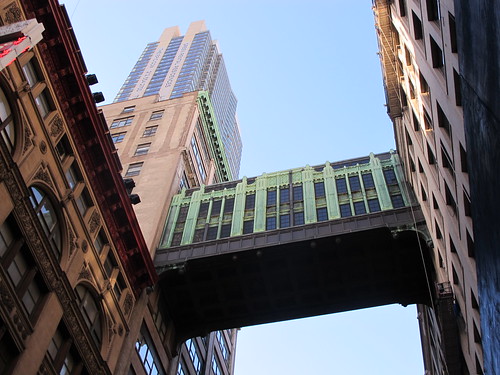
West 32nd Street is hectic to say the least. Since it isn't on my daily commute, I usually only go to buy some inexpensive stuff that I "need" at Jacks, eat something amazing in Koreatown, and also to stare at the Gimbels Traverse, sometimes also referred to as the Gimbels Skybridge, a relic of retail history and architecture that focused on aesthetics and function.

Photo: 34SP, A. Kumer
This Art Deco bridge, with its oxidized copper cladding makes me happy as I try to navigate the insane pedestrian traffic on 32nd Street. In 1925 the retailer Gimbels bought the Cuyler building at 116 West 32nd Street to use primarily for their administrative offices. Built by the Cuyler Realty Co. in 1911, it sat across the street from the Gimbels flagship store (now Manhattan Mall) at 1275 Broadway. I've posted this picture before, but here is the Cuyler building a year after completion, and thirteen years before the Traverse.

Photo: MCNY
Right after the purchase, Gimbels hired architects Richard Harold (R.H.) Shreve and William Lamb (later to become 2/3 of the Firm Shreve, Lamb & Harmon) to design the three-story passageway with copper cladding to connect the two buildings. (For 34th Street district enthusiasts, this firm also designed the Empire State Building, built in 1930-1931, and 1250 Broadway, built in 1967-1968; in our sister BID, Bryant Park, they designed 500 Fifth Avenue, built in 1931.)

The photo below shows West 32nd Street in 1977, including the traverse, the vertical Willoughby's sign (now Jack's), a vertical Gimbels sign, and at the southwest corner The Donald, now The Continental.

Photo: 1977, Whiskeygonebad flickr
Here it is now from half a block further east.

Photo: 34SP, A. Kumer

Other sources:
NYT. "Cuyler Building Sold for $2,000,000 . . . " December 16, 1921
Bowery Boys

Tuesday, November 29, 2011

From the Archives: Finding a Bargain under the Gimbels Traverse

In this post, 34SP's archivist Anne Kumer shares some 34th Street history. This post also appears on NYC Circa, Anne's history blog about New York City and its public spaces and buildings.


I LOVE dollar stores, especially Jack's. It's chaotic for sure (I have to be in the mood for an adventure), but there are great deals on a huge variety of merchandise. The first Jack's was opened at 16 East 40th Street, between Fifth and Madison Avenues. In 1994 Jack opened a second store on the first floor of 110 West 32nd Street, between Sixth and Seventh Avenues, and three years later, a closeout retail store called Jack's World, on the 2nd and 3rd floors in the same building. Here is 110 West 32nd Street in 1912 -- it's the middle building with the sexy cornice and Penn Station in the background to the west.

Photo: MCNY
The photo above was taken just after the completion of its neighbor to the west, known then as the Cuyler Building, and later as the Gimbels Administration Building, and even later, as one host to the Gimbels Traverse, or skybridge (more on that later). As for the "Jack's" building -- visible below to the left of the skybridge -- it was probably built in the early 1900s.

Manhattan, West 32nd Street, b/t Sixth Avenue & Seventh


According to  Walter Grutchfield's extremely informative website on New York City wall signs, 14 to 42, the building was occupied by a company called Alliance Press from about 1907 to 1938, and Protective Ventilator Co. from 1910-1916.  In 1916, Willoughby's Camera Stores purchased the building, setting up a much-loved shop on the ground floor. The camera and photography store (one of NYC's oldest) was there until 1994, bringing us full circle to Jack's. Again, 14 to 42 gives a concise history of Willoughby's, so I'm not sure I need to.  I can, via the MCNY photo collection, contribute a Willoughby's window from 1945:

Photo: MCNY

Monday, November 14, 2011

From the Archives: The Rise and Fall of Penn Station

In this post, 34SP's archivist Anne Kumer shares some 34th Street history. This post also appears on NYC Circa, Anne's history blog about New York City and its public spaces and buildings.

Penn Station, neighbor to the still standing Farley Post Office is mostly remembered as one of New York City's great losses. The photo below shows the station as most choose to remember it -- a beautifully designed structure filled with natural light, that makes train travel look like the best idea ever. For out-of-town travelers new to the city, it was often their first glimpse of New York City.


Penn Station, 1935. Photo:New York Public Library

Before Penn Station was conceived of and built, railroad service terminated in Jersey City on the western side of the Hudson River. From there, passengers boarded a ferry into the city. The Pennsylvania Railroad Company (PRR) put forth several proposals to bring service into the city, including elevated tracks over the Hudson. It was eventually decided to tunnel under it instead, and an initial excavation began on July 21, 1880 to link the new passage with an existing, partially completed tunnel. Unfortunately this effort ended in disaster for several workers who perished when the tunnel collapsed.

The disaster cast a shadow on the project, and it wasn't until twenty years later that PRR President Alexander Cassatt, announced plans to resume the project, tunneling under the Hudson and into the City at West 34th Street.

Architecture firm McKim, Mead & White was chosen to design the station; construction started on May 1, 1904, and was completed in 1910. September 8, 1910 was the official opening day of the station, though full train service didn't begin until November 27, 1910.

The early stages of construction, photo: Library of Congress


Penn Station in 1910 looking southwest. Photo: Detroit Publishing Co., Library of Congress


Known for their Beaux-Arts style, McKim, Mead & White placed Doric columns along the eastern facade, crowning them with twenty-two eagles. The form used for the eagles was sculpted by Adolph A. Weinman.


The station had high vaulted glass ceilings that let in natural light and lent a refinery to the terminal, almost as if it was a museum devoted to transportation, rather than just a terminal. This feature of the building also likened it to another architectural jewel that burned down years before, the Crystal Palace exhibition hall, built mostly of glass and steel and erected in Bryant Park in 1853.

Like all good architecture photos, this one is entirely without people.
Penn Station interior, 1910. Photo: Shorpy's


With the increasing practice of traveling by car in the 1950s, the railroad industry began to suffer financially. The station and air rights were eventually sold and plans for the new Penn Station and Madison Square Garden were announced in 1962. In exchange for optioning out the air rights over Penn Station, the PRR was permitted a new station underneath the future site of MSG at no cost to the railroad company and a 25% stake in the new MSG sports complex. Destruction began on October 28, 1963. The following photos are housed at the Museum of the City of New York, and were taken by one of my favorite living photographers, and I'm fortunate to say, friend, Aaron Rose.
The demolition of Penn Station, 1964-1965. Photo: MCNY, Aaron Rose


The demolition of Penn Station, 1964-1965. Photo: MCNY, Aaron Rose
The public outcry against the destruction of Penn Station was significant, though not enough to save the building. It did however, help solidify and unify architectural preservation efforts, and led to founding of the Landmarks Preservation Commission (LPC) in 1965. 

Additional sources:
The Late, Great Penn Station by Lorraine Diehl (My favorite book on Penn Station.)
Forgotten NY has a lot of digestible facts and pictures
Library of Congress digital photo archive

Wednesday, November 19, 2008

Why?

I used to have a friend who, after over-imbibing heady spirits, would moan "Why? What does it all mean? Whyyyy?" My Black Irish heritage relished every tortured, existential "why" moment we spent together.

But here is one "why" I can answer: Why am I writing a blog about shopping on 34th Street, and why am I writing a blog about shopping in Bryant Park? Let's dish:

I work for two business improvement districts in midtown Manhattan, the 34th Street Partnership and Bryant Park Corporation. We're non-profit, urban management companies that run public spaces in the city. I know, you're nodding off already. So I'll just tell you that we like to obsess about: trashcans. I can no longer look at OPT (other people's trashcans) without shaking my head and pontificating on the horror of throwing one's trash into an old, beat-up oil barrel. I do this till my husband yells at me to stop ruining his day.

Besides trashcans, we obsess on: street furniture (newsboxes, bike racks etc. all designed by our very talented industrial designer Ignacio Ciocchini), horticulture (Bryant Park, Herald & Greeley Squares, and planters and hanging baskets you see on 34th Street, all thanks to our very talented horticulturalist Maureen Hackett), capital projects (lightpoles, street signs, street corners and crosswalks, etc.), sanitation, security, and retail. We also have an events department that oversees all the events in Bryant, Herald and Greeley.

I work for the retail department and, through blogging, help promote the stores on 34th Street and contribute to the Bryant Park blog. So I go out to our 34th Street stores, or The Holiday Shops during their tenure in the park, take pictures and show you what they've got. All to lure you into our districts and get you to shop, mwahaha! No, actually, it's not sinister at all. 34th Street is more of an outdoor mall in the middle of Midtown Manhattan. And Bryant Park is one of the prettiest city parks you'll ever visit.

Thanks for letting me rant, and please feel free to email me any questions you may have about funding, streetscape elements, retail stores, or how badly I (ahem, "we") want Topshop on 34th Street. You know, the really important stuff.

Monday, November 5, 2007

When Co-Workers Dress Alike

Could it be that when two people work closely together, they start to look alike? You know, like old married couples and pets and their owners? Hmm, let's check out our own Martin & Mazza, a young, smart team who favor a style I like to call "preppy punk." They've spent many months this past year working together in a very small office.

Unfortunately, we only recently started documenting this phenomenon. Here's White Shirt Day: The evening before White Shirt Under Gray Sweater Day (below), Martin tried to throw Mazza off with a text full of crazy wardrobe misinformation:


As you can see, he texted for naught. What's at play here? Are their style moons perfectly aligned or did the intimate office environment influence vital wardrobe decisions? Let's examine the facts: both wear great belts; both favor the dark skinny jean; both keep the tailoring neat; both adopt a stand-out signature [Martin with hats and Mazza with glasses (above) and red nails (left)]. The plot thickens. We'll continue tracking this modern nature v. nurture mystery as more clues emerge.


Where Martin shops in the district: H&M, Macy's, Gap.
Where Mazza shops: Uniqlo and Urban Outfitters. I'll convert her to a district store yet.

Martin says: Get undershirts at the Gap and make them fitted and more comfortable by drying them on high heat. Ahh, nothing like the shirt well done from the dryer.

Mazza says: She'll never buy anything from Sarah Jessica Parker. Mazza's tough, but wait till she hears Bitten has pea coats for $19.98.


H&M, 435 Seventh Avenue at 34th Street, 212-643-6955
Gap, 60 W. 34th at 6th Avenue, 212-760-1268
Macy's Herald Square, 151 W. 34th St. btwn Broadway & 7th, 212-695-4400
Steve and Barry's, Manhattan Mall, 100 W. 33rd at Broadway, 212-564-1959